Question: Compare and contrast two examples of abstract work
Pablo Picasso and Francis Bacon
By Jacqueline Paesano Wood
Pablo Picasso and Francis Bacon were two of the most prolific artists of the last century. It is said that Pablo Picasso was Francis Bacon’s inspiration to become an artist. Bacon developed his own style based on Picasso’s surreal figurative paintings.
In this essay I will be examining how both artists discombobulated and distorted the figures they painted, and how they expressed themselves similarly and in different ways. I will compare their approaches with regards to their use of line, colour and process. I will also look at the influence their upbringings had on their painting narrative. In addition, I will be looking at two paintings from each artist which they painted of their lovers. From Pablo Picasso I will examine ‘The Reve’ (The Dream), 1932 and ‘Weeping Woman’, 1937. From Francis Bacon I will explore ‘George Dyer Talking’, 1966 and ‘Portrait of John Edwards’, 1988. Firstly, I will be considering Pablo Picasso and then Francis Bacon.
Pablo Picasso
Pablo Picasso was brought up in a fairly stable environment close to his mother and supported by his father. His father, who was an art teacher, taught a young Picasso to draw and paint. Picasso appeared to be a talented artist at a young age. Impressed by his sons ability he sent Picasso to the Royal Academy of Fine Arts of San Fernando, Madrid.
Picasso’s sister died of diphtheria at age 8, when he was 13 years old. This was thought to, understandably, have had a huge emotional effect on him, which greatly influenced his need to paint.
“In relationships he was obsessed with women. For Picasso, women where the indispensable source of his life force. Without a woman by his side, even if for only a short while, he was incapable of fully expressing his genius. But his love for women was not selfless and self-sacrificing. It was overbearing, dominating, and demanding. Along with beauty and intelligence, total devotion and submissiveness were pre-conditions of a relationship. But buried deep under the Spanish machismo there laid fears and complexes that made his affairs complicated and troubled.” (Duchting, 2008, P93)
“Le Reve“(The Dream)

Picasso, 1932, Private collection of Steven A. Cohen
Picasso is said to have painted this picture in one afternoon. It is a portrait of his mistress Marie-Therese Walter who was then twenty four years old, he was fifty years old.
Picasso used very bold, primary paint colours. The bright red, yellow and blue are in contrast to the pale female figure, making it really stand out. The subtleties of the skin and the breast revealed are in pale pastel lilac and blue. The lines of the body and seating are curvaceous, with long thick flowing lines.
He has not painted ‘Le Reve’ as a still life. Picasso did not paint as he saw his subject, but as a representation and interpretation of how he felt.
There was great controversy about this painting, as it looks like he has painted a penis shape over the top side of the woman’s face, using the detail of the eye to enhance this. Others have also said the woman is masturbating.
It appears that his passion about this woman is impressed upon her. It’s like there was no distinction between the person and his desires. It feels to me that he wants to become at ‘One’ with the woman, desperate to connect, or feel whole, somehow physically him becoming part of her; with that being an actual impossibility, except as an idea. This painting was named ‘Le Reve’, ‘the dream’, which seem very apt for an egocentric Picasso. It seems the image of his lover dreamily fantasising about Picasso’s very own penis was the kind of driving energetic force that fuelled his prolific ability to create.
Weeping woman

Picasso, 1937, Tate Modern, London
Picasso painted this portrait of Dora Maar (she was his mistress from 1936 to 1944).
“It was about the Spanish Civil War was the bombing of the Basque town of Guernica by the German air force, lending their support to the Nationalist forces of General Franco. Picasso responded to the massacre by painting the vast mural Guernica, and for months afterwards he made subsidiary paintings based on one of the figures in the mural: a weeping woman holding her dead child.” (TATE, website)
In this painting, as with so many of his paintings, Picasso used very bright primary and secondary colours. The background is angular, the hair and the outline of the face and hands are soft and rounded. The facial area is pale blue, representing the generic colour of tears. The face is very angular and fragmented, with sharp triangular shapes. The hands are also in the facial area. This area looks a little like shattered glass, showing the emotion and intensity of being broken, shattered and in complete and utter grief. How sharply the tears fall from her eyes. There is so much pain in the cutting angles. The hands that seem to be at her face wiping, consoling, the tears becoming part of them. Picasso has conveyed so much emotion in this picture.
Picasso said in regards to his lover and sitter Dora Maar that “For me she’s the weeping woman. For years I’ve painted her in tortured forms, not through sadism, and not with pleasure, either; just obeying a vision that forced itself on me. It was the deep reality, not the superficial one.”(Léal, 1969, p369)
It seems that Picasso used this painting to express his own grief regarding the bombing of the Basque town of Guernica. The painting also conveys his idea of the women in his life as submissive and as sufferers, with Picasso being the dominating force in their life.
“Dora, for me, was always a weeping woman and it’s important, because women are suffering machines.”(Malraux, 1976, p138)
Francis Bacon
Francis Bacon had a tough childhood. He had a dominating father who was a racehorse trainer from Australia. A young Bacon would dress up flamboyantly wearing women’s clothes. His father was intolerant of his behaviour and would beat him. At age 17 he was sent away from the family home as his father could no longer tolerate him. Bacon’s homosexuality upset his father and when he found him dressed in his mother’s clothes it was the last straw.
Francis Bacon never had any formal training as an artist, but after seeing a Pablo Picasso exhibition Bacon was inspired to give painting a try.
“Picasso’s surrealist works not only bolstered a whole artistic generation, but encouraged Francis Bacon to engage the works of surrealism into his thinking and imagery. The series which most impressed Bacon is the set of Picasso drawings and paintings created in Cannes and Dinard during the summers of 1927 and 1928.”(Berggruen, 2004, P163)
George Dyer Talking

Photo Left; Deakin John. (1964) Reece Mews Studio.
Painting Right; Bacon, (1966) Private collection
This panting of Dyer has a very contrasting background to the reality of the sitters back drop, which was Bacon’s very messy, cluttered art studio. The only original features painted in picture are the pieces of paper lying at Dyer’s feet. He painted the room as rounded, the perspective is off, however it didn’t seem that important to Bacon. The walls are a thick purple band with a dirty brown ceiling with a solitary light bulb. The light bulb cord and the light pull’s shadow lines are swinging in different directions. The mauve, red floor seems to dance and has a Van Gogh quality to it.
Overall the figure is curved with ‘s’ shaped lines throughout, giving a twisted and contorted look to Dyer’s body. The blurring of the hands and feet give the appearance of them interlocking in bondage. The distortions in the face, where the mouth is, blend and gives the impression that the mouth has been gagged or taped. The title of this painting ‘George Dyer Talking’ is almost like a taunt by Bacon towards Dyer. Bacon and Dyer were in a sadomasochistic relationship, Dyer the Sadist and Bacon the Masochist. So from this perspective the painting makes sense, the taunting element in the painting may have been the proverbial ‘carrot dangling’ to enrage his partner. Therefore, Bacon would receive the beatings he craved. Dyer was perhaps not as dominant and as violent as Bacon would have liked, hence the provoking painting.
Bacon said that to change someone’s face in the way that he did had an effect on the sitter. It was like an attack on them.
“Because people believe, simple people at least, that the distortions of them, are an injury to them. No matter how much they feel for you or how much they like you.” (Sylvester, 1966, BBC)
Though Dyer was the sitter, I think that behind the blurred face and hairstyle it actually looks more like Bacon than Dyer. The way the body has been sculpted brings the reality to the viewer that the body is simply a piece of meat. Bacon saw a beauty in the carcasses that hung from Butchers hooks. He felt he wanted to paint such shocking realities of flesh, that most people shy away from examining.
Portrait of John Edwards
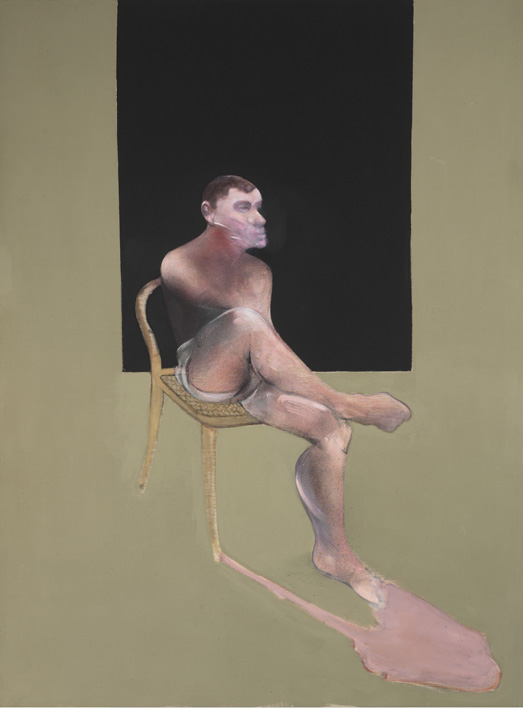
Bacon, (1988) Tony Shafrazi Gallery, New York
John Edward was said to have been Francis Bacon’s closest friend for eighteen years, with the relationship having a paternal aspect to it.
Edwards was homosexual but denied that he and Bacon were lovers. The pose in this painting is very similar to Bacon’s portrait of Dyer, though his legs are crossed and his hands folded in and the body is not as contorted and bound. There is softness in the painting style and colours compared to the violent feeling in Bacon’s earlier works. It suggests that there was a softening in Bacon emotionally and that his need to taunt his subject or rip them apart had lessened.
The features at the front of the face are over pronounced, yet not mashed bashed or gagged. It does look like Edwards, however Bacon has not impressed his own facial qualities into the painting. There is a shadow image pouring onto the floor that is in a flesh tone, it’s like Edwards’ image is melting on to the floor. He is wearing white underwear rather than being naked as in the painting of John Dyer. Behind him there is a solid black rectangle which reminds me of Kazimir Malevich’s, The Black Square, 1915.[1]
The impression is that Bacon became more content in his later life. The violence in his art had mellowed. It seems the main driver in his relationship had become less about sex and sadomasochism, but about companionship. After 18 years together Bacon died and left all his fortune to John Edwards, valued at eighteen million pounds.
The Juxtaposition of Pablo Picasso and Francis Bacon
It is well documented that Francis Bacon was inspired by the art of Pablo Picasso. Bacon went on to paint his own prolific body of art, expanding on Picasso’s technique and creating his own unique expression. Picasso’s style of discombobulating the face and body of his subjects conveyed a very powerful emotional narrative in his paintings; using the bright colours, bold outlines and symbolic shapes, mixed with his ability to convey deep passion, emotions and grief in a natural child like expression. My view is that this approach is interesting because it disarms you as the viewer. The images are easy to look at and could be passed by as jolly pictures, but on further examination there is a lot more to be seen, with some subjects being violent expressed.
In Francis Bacon’s work his paintings make the viewer feel instantly disgusted. From my own experience, looking at some of his painting about 10 years ago, I didn’t want to explore them at all, feeling they were just too depressing to look at, yet now I have found the whole examination fascinating in his portrayal of life and death. Compared to Picasso’s child like paintings, within the discombobulating of the figures in Bacon’s painting they are disfigured, but they still have flesh tones, the colour more blended and a sense of movement in the a total concentration of the violence regarding his lover.
Picasso seemed to be easing or lulling you into his emotional expression. Where Bacon wants you to feel the hit. Which would seem to convey their own personality types. Picasso a narcissist personality, grooming, idolising then dominating his lovers. In contrast Bacon wanting to be dominated, a masochist expressing violence and bondage in his paintings. He expresses it clearly. There is no luring in, his expression is completely apparent. Picasso seems to have focussed on passion and life, where Bacon focused on passion and death. Ultimately the same thing but juxtaposed. Picasso believing he was the greatest painter that ever lived. Bacon was easily disparaging of many his own art works. He was quick to recognise what he thought worked and did not in his paintings. In my exploration of both artists I disliked Pablo Picasso more as a person than I thought I would. Surprisingly I warmed to Francis Bacon. But that may have been because I was able to see him talking in interviews and hear him speak directly. Who knows if I had heard Picasso speaking I may have felt differently.
Nonetheless I have found both artists completely fascinating. A darkness and an innocence in both artists. They are an antithesis yet complimentary. I shall take inspiration from both in my continuing art practice.
Bibliography
Berggruen, Oliver 2004. Bacon Picasso and Surrealism. In: Barbara Steffen. Norman Bryson. Francis Bacon and the Tradition of Art. Place: Riehen, Basel. P 163.
Hajo Duchting, 2008, Pablo Picasso: Living Art, Munich, Prestel, Page 93
Léal, Brigitte: “Portraits of Dora Maar”, Picasso and Portraiture, page 396. Harry N. Abrams, 1996)
Malraux, André: Picasso’s Mask, page 138. Holt, Rinehart and Winston, 1976
Television broadcast
David Sylvester (interviewer),“Francis Bacon Fragments Of A Portrait” broadcast on BBC1, 18 September 1966
[1] Kazimir Malevich’s, The Black Square, 1915. This painting has been interpreted as a new beginning a wiping of a slate to starts afresh.” Malevich promoted it as a sign of a new era of art and he saw it as beginning at zero” (Holtham, Moran(2014)
tones, the colour more blended and a sense of movement in the a total concentration of the violence regarding his lover.
Picasso seemed to be easing or lulling you into his emotional expression. Where Bacon wants you to feel the hit. Which would seem to convey their own personality types. Picasso a narcissist personality, grooming, idolising then dominating his lovers. In contrast Bacon wanting to be dominated, a masochist expressing violence and bondage in his paintings. He expresses it clearly. There is no luring in, his expression is completely apparent. Picasso seems to have focussed on passion and life, where Bacon focused on passion and death. Ultimately the same thing but juxtaposed. Picasso believing he was the greatest painter that ever lived. Bacon was easily disparaging of many his own art works. He was quick to recognise what he thought worked and did not in his paintings. In my exploration of both artists I disliked Pablo Picasso more as a person than I thought I would. Surprisingly I warmed to Francis Bacon. But that may have been because I was able to see him talking in interviews and hear him speak directly. Who knows if I had heard Picasso speaking I may have felt differently.
Nonetheless I have found both artists completely fascinating. A darkness and an innocence in both artists. They are an antithesis yet complimentary. I shall take inspiration from both in my continuing art practice.
Bibliography
Berggruen, Oliver 2004. Bacon Picasso and Surrealism. In: Barbara Steffen. Norman Bryson. Francis Bacon and the Tradition of Art. Place: Riehen, Basel. P 163.
Hajo Duchting, 2008, Pablo Picasso: Living Art, Munich, Prestel, Page 93
Léal, Brigitte: “Portraits of Dora Maar”, Picasso and Portraiture, page 396. Harry N. Abrams, 1996)
Malraux, André: Picasso’s Mask, page 138. Holt, Rinehart and Winston, 1976
Television broadcast
David Sylvester (interviewer),“Francis Bacon Fragments Of A Portrait” broadcast on BBC1, 18 September 1966
Artworks
Bacon, Francis.(1966) Portrait of George Dyer Talking [oil on canvas]. Private collection
Bacon, Francis.(1988) Portrait of John Edwards [oil on canvas]. Tony Shafrazi Gallery, New York
Picasso, Pablo.(1932) Le Rêve The Dream [Oil on canvas]. Private collection of Steven A. Cohen
Picasso, Pablo.(1937) The Weeping woman [Oil on canvas]. Tate Modern, London.
Photo
Deakin, John. (1964) George Dyer, Reece Mews Studio, LONDON.
From webpage http://uk.phaidon.com/agenda/art/articles/2014/january/21/will-bacons-george-dyer-portrait-break-records/
Websites
http://www.tate.org.uk/art/artists/francis-bacon-682
Holtham, Susan and Moran, Fionatan (28 August 2014), Tate, Five ways to look at Malevich’s Black Square. Available at: http://www.tate.org.uk/context-comment/articles/five-ways-look-Malevich-Black-Square (Accessed:29/03/2017)
Websites
https://en.wikipedia.org/wiki/Neoclassicism
https://www.nationalgalleries.org/whatson/exhibitions/picasso-modern-british-art/francis-bacon
http://www.pablopicasso.org/classicism.jsp
http://www.tate.org.uk/learn/online-resources/glossary/s/surrealism
http://www.bbc.co.uk/news/entertainment-arts-16985065
Picasso in The Metropolitan Museum of Art: A Behind-the-scenes Tour with the Director
http://www.metmuseum.org/toah/works-of-art/60.87/
https://www.theguardian.com/artanddesign/2009/nov/22/francis-bacon-legacy-revisited
http://francis-bacon.com/life/family-friends-sitters/john-edwards
http://luxurytrump.com/auctions/francis-bacons-painting-portrait-of-george-dyer-talking/
https://www.theguardian.com/artanddesign/2009/nov/22/francis-bacon-legacy-revisited
http://www.tate.org.uk/art/artists/francis-bacon-682
https://en.wikipedia.org/wiki/Portrait_of_George_Dyer_Talking

